
Google.com Scam Sent via Gmail API - DMARC Passed, No Account Compromise

February 11, 2026

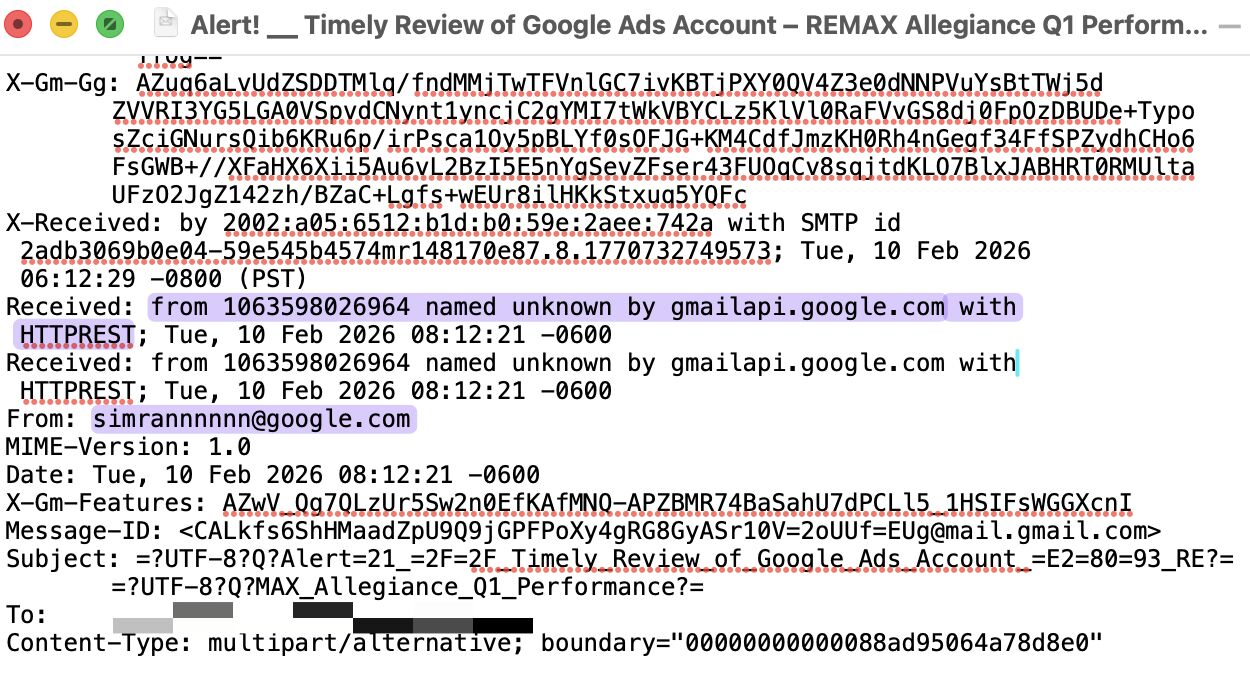
A scam email was sent from a legitimate @google.com address via the Gmail API and passed SPF, DKIM (signed by Google), and DMARC with p=reject. No account was compromised, and there were no phishing links or attachments - just social engineering designed to trigger a reply. This case shows that authentication alone cannot stop abuse when attackers operate through trusted infrastructure.

Google.com Scam Sent via Gmail API - DMARC Passed, No Account Compromise

Someone just sent a scam email from @google[.]com through the Gmail API with DMARC p=reject passed, DKIM signed by Google, and SPF authenticated, bypassing several internal security controls.

Urgency in the subject line, a request to review Q1 ads performance, tailored to the victim's industry, expecting them to reply. No phishing links, payloads, or attachments were inside.

For this scam to work, the threat actor must have access to a @google[.]com mailbox and be able to read incoming replies and continue the conversation.

But this wasn't a classic BEC. No Google account was taken over.

Attacks are getting more sophisticated.

Related posts
All posts
Google.com Scam Sent via Gmail API - DMARC Passed, No Account Compromise

A scam email sent from @google.com passed SPF, DKIM, and DMARC without a compromised account. Here’s what it reveals about modern email threats.

Google.com Scam Sent via Gmail API - DMARC Passed, No Account Compromise
When Vendors Control Your DNS: A Hidden DMARC Security Risk

A real-world example of how third-party DNS control can silently block DMARC visibility, redirect domain telemetry, and introduce serious email security and data exposure risks.

When Vendors Control Your DNS: A Hidden DMARC Security Risk
2.3 million emails. One exposed API key. $10K bill.

How DMARC forensics exposed an API key leak, 2.3M unauthorized emails, and a $10K bill.

2.3 million emails. One exposed API key. $10K bill.