Why “Spam Trigger Words” Don’t Actually Exist
August 20, 2025
Spam filters evaluate sender reputation, engagement, behavior, and infrastructure, making keyword-based “spam trigger words” largely irrelevant today.

Spam filters evaluate sender reputation, engagement, behavior, and infrastructure, making keyword-based “spam trigger words” largely irrelevant today.
Why "spam trigger words" is fake.
Most modern spam filters don’t rely on just scanning for keywords like “free money” or “limited time offer”. Instead, they use advanced statistical and behavioral models, especially Bayesian filtering, machine learning, and sender reputation, to assess whether an email is spam.
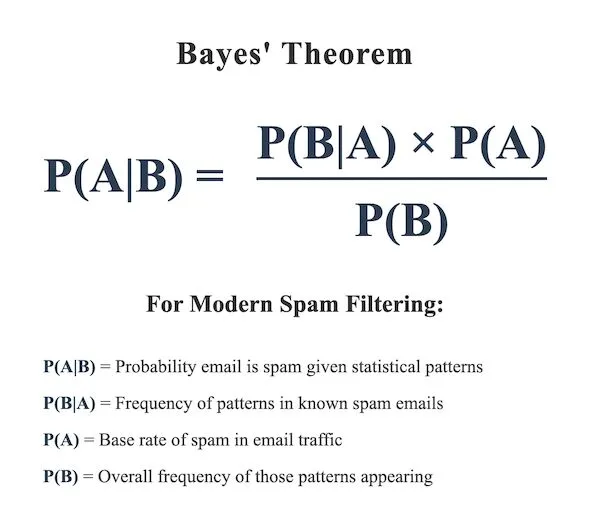
Bayesian filtering is a probabilistic approach to classifying emails as spam or not spam. It works by calculating the likelihood that an email is spam based on the frequency of certain words and patterns in previously seen emails.
Bayesian filtering is just part of a larger decision making process that includes sender reputation, engagement signals, infrastructure signals, and behavioral patterns.
Even if your content is clean, poor sending behavior, like sudden volume spikes, can land you in spam.
So while your content does matter, it’s still a part of a broader matrix.
You’re judged not only by what you say, but how you say it, who you are, and how recipients react.